


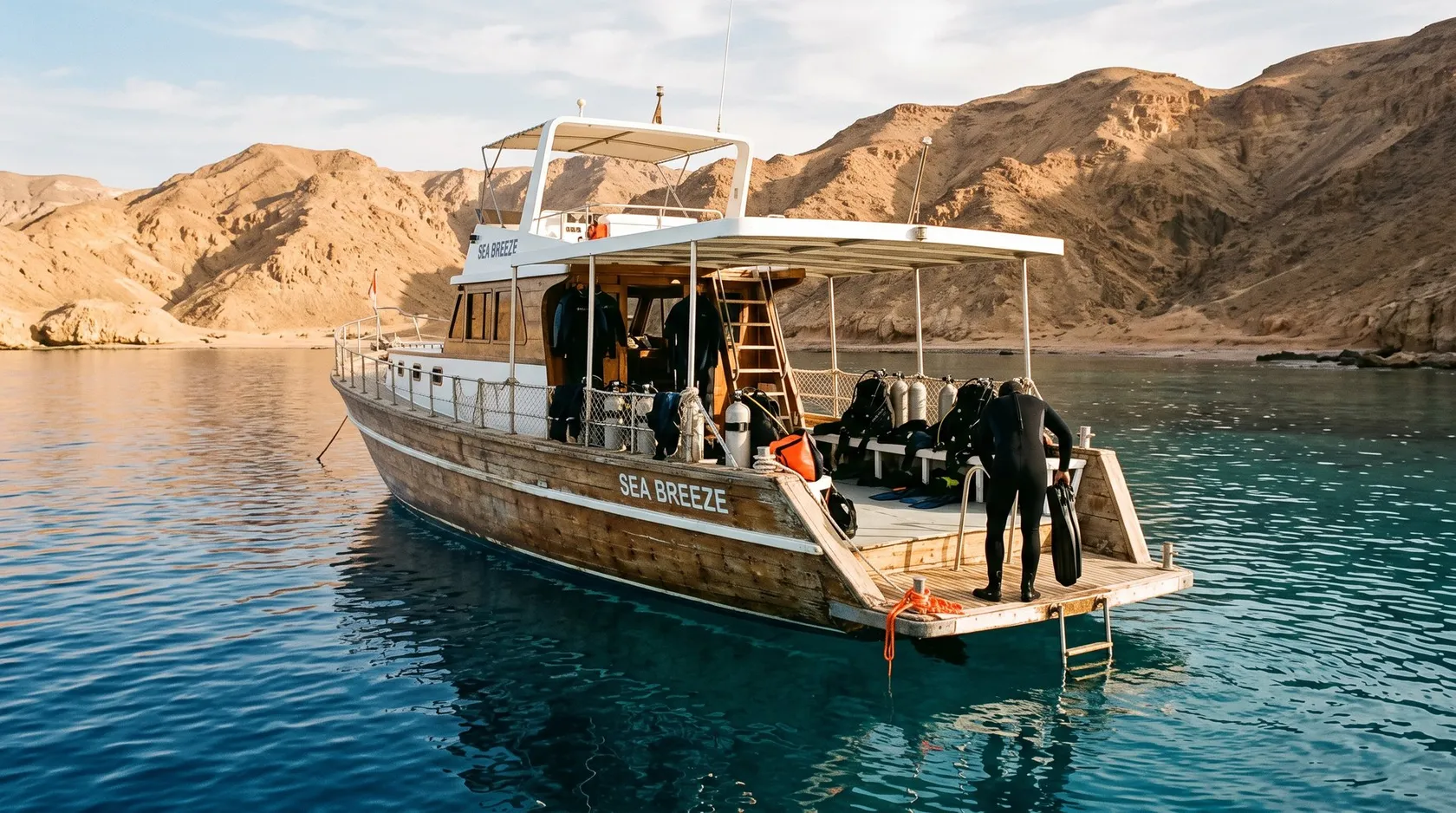
Egypt gets written off as the beginner destination. It isn't. Here's how to pick between a liveaboard, the Sinai, or a hotel with a house reef, and what to check before you book.
There is a particular tone divers use when Egypt comes up. Slightly dismissive, a bit been-there. The place you did your open water, before the real trips started.
We think that is wrong, and the numbers behind it are worth looking at honestly. Five hours from most of Europe, no malaria tablets, no eleven-hour layover in a city you will never see, and a reef system that holds its own against destinations people plan for years.
The case for close
The biggest thing Egypt has going for it is not the coral. It is the fact that you can be underwater the day after you decide to go.
That changes what a dive trip can be. It makes a long weekend viable. It makes taking a nervous friend on their first proper trip realistic, because if it goes badly nobody has burned two weeks and four thousand euros. And it means you can go often enough to actually get good, which is worth more than one spectacular trip every three years.
The range of sites helps too. There is easy, shallow, forgiving diving for people fresh out of certification, and there are walls, currents and wrecks that will keep experienced divers busy for a decade.
Going south, and why it is worth the hassle
A lot of liveaboards leave from Port Ghalib, which opens up the deep south. Logistically it asks a bit more of you: most international flights land in Hurghada, so you add a transfer or a bus down the coast to the start of the trip.
Do it anyway. The general rule in the Egyptian Red Sea is that the further south you get from Hurghada, the better everything becomes. Reefs that have been left alone, proper drop-offs, coral gardens with the kind of density that makes you check your gauge less often than you should.
The transfer is a few hours of your life. The difference in what you see is the whole reason you came.
Not all dive sites are the same
Egypt has genuinely world-famous sites, and fame does what fame always does. Some places now see several boats arriving at once, which means sharing a reef with more people than you would choose.
This is not a reason to stay home, it is a reason to read the itinerary properly. A well-planned route can keep you away from the busiest spots for most of the week. Quiet reefs, healthy coral, that feeling of being somewhere rather than queuing at it. The good stuff is still absolutely there. It just is not always at the sites with the famous names.
Compare itineraries, not just prices. Two boats at the same price can offer completely different weeks, and the schedule tells you far more about the trip you will actually have than the cabin photos do.
You do not have to take a boat at all
A liveaboard is one way to dive Egypt, not the only way.
The Sinai side has Dahab and Ras Mohammed National Park, both of which are excellent and neither of which requires you to live on a boat for a week. And there is a version of a dive holiday that gets unfairly sneered at: a good hotel with a proper house reef, day trips to the sites you want, and a bed that does not move at 3 a.m.
That last option is worth taking seriously, especially if one of you dives and one of you does not, or if seasickness is part of your life. Caroline gets seasick like clockwork on day one of every boat trip, so we know exactly how much that matters. Diving from land means less logistics, more flexibility, and nobody has to negotiate a shared cabin with strangers.
The part we are not going to skip
In recent years there have been accidents in the Egyptian Red Sea, and reports about poorly maintained vessels. That has made some divers wary of liveaboards there, and pretending otherwise would be dishonest.
The answer is not to avoid the region. It is to choose carefully. Look for an established operator with a track record. Read recent reviews, not the ones from four years ago, and read the mediocre ones as well as the glowing ones. Ask directly about safety standards, about the age and maintenance of the boat, about how many crew are on board. A beautiful itinerary is worth nothing if the basics are not right, and a good operator will answer those questions without getting defensive.
If anything about the answers feels evasive, book something else. There are plenty of boats.
So, is Egypt still worth it?
Yes, and not as a compromise.
Warm water, visibility that spoils you, reefs that hold their own against places on the other side of the planet, all of it inside a short flight. Whether you take a liveaboard through the deep south, spend a week on the Sinai, or base yourself near Marsa Alam and dive from the beach, the same rule keeps applying: the further you get from the busiest spots, the more the Red Sea shows you what it actually is.
Planning one? Tell us where you are thinking of going, we are nosy about other people’s itineraries. Stay soggy.