


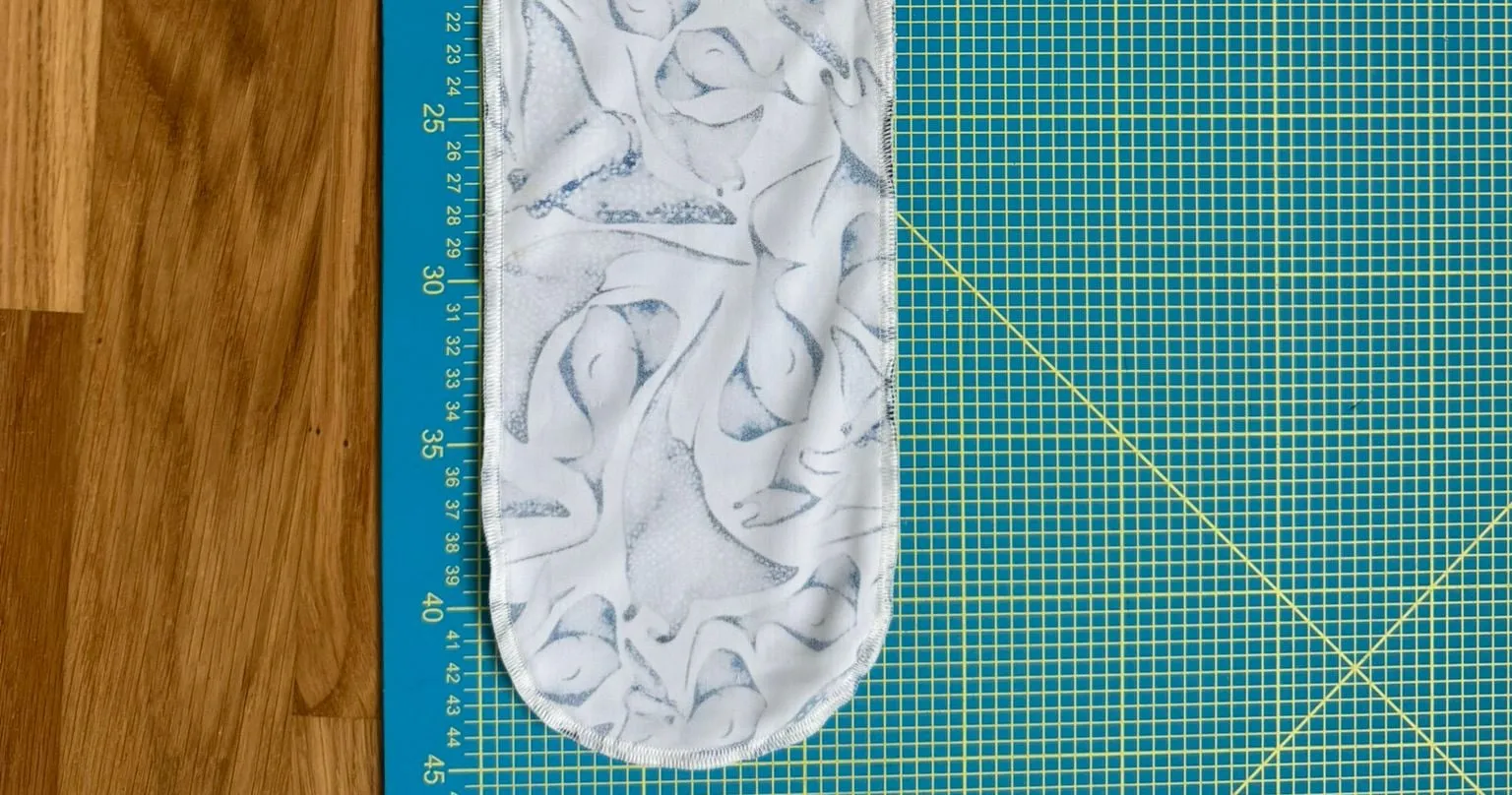
No factory would touch a tiny unknown brand. So I printed my own fabric, got the print orientation completely wrong, and ended up with three sewing machines on my desk.
We had prints we loved and an idea we believed in. What we did not have was anyone willing to make the socks. Every factory we asked wanted quantities and money that a pre-launch brand of two ocean addicts simply did not have yet. Chicken, meet egg.
So I did the only thing that made sense at the time, which was also slightly unhinged. I decided to make the first ones myself. Small problem. I did not know how to sew.
The fabric came first
Before any of the sewing there was a more basic question. Where do you get fabric with your own print on it, in a quantity that is not “one roll, minimum”?
We landed at CottonBee, a print shop that does sublimation printing on stretch fabric by the meter. You upload your pattern, pick the base fabric, and a few days later a parcel with your own design shows up. They also print small sample swatches, which turned out to be the most useful thing in the entire process. For a few euros you get to see what your print really looks like on fabric, in daylight, at actual scale. On a screen everything looks great. On lycra, some things do not.
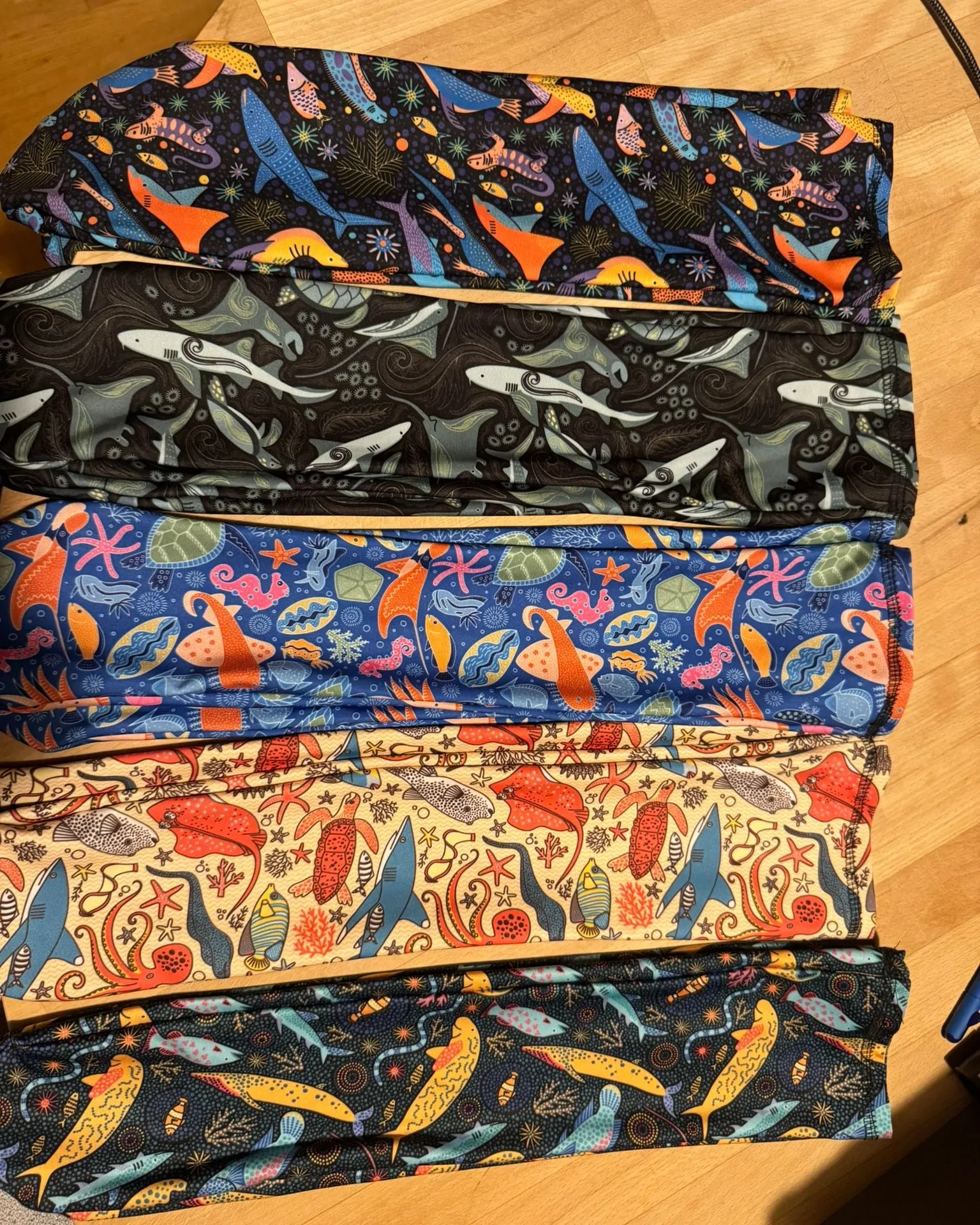
Five designs, five places we have dived. Galápagos, Raja Ampat, Maldives, Red Sea and Australia.
The mistake that cost me an entire order
Here is the part I did not see coming, and it is the reason this article exists.
Stretch fabric has a direction. A print has a direction. I had no idea the two had anything to do with each other.
I uploaded the first design, ordered a meter, cut my sock pieces, sewed them together and pulled the thing on. The stretch ran around the calf, which is exactly what a sock needs, and which meant the print got hauled sideways across the widest part of my leg. All those carefully drawn rays and sharks, pulled wide and thin. Not broken. Just wrong, in the way you cannot unsee once you have seen it.
So I reordered everything, rotated ninety degrees. To this day the files in our CottonBee account are called things like “Galapagos for Print_gedreht”, German for rotated, which is really just a permanent little monument to me getting it wrong the first time.
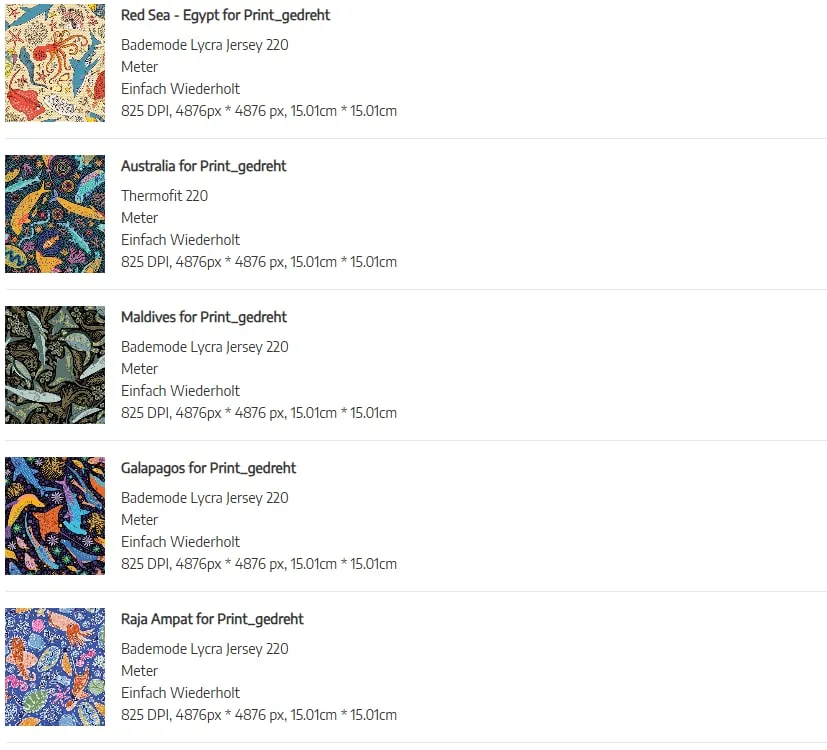
Five designs, five files, every single one of them rotated.
That was also the first time I properly had to understand pattern design. We had worked with an illustrator on the artwork, which was its own adventure and a story we told separately. But artwork landing in your inbox is not the end of it. Somebody still has to work out at what resolution and in which orientation the file goes to the printer so the repeat lands right on the fabric. Ours run at a 15 cm repeat. Getting that wrong is not a design problem, it is a maths problem, and it cost me a whole order to learn.
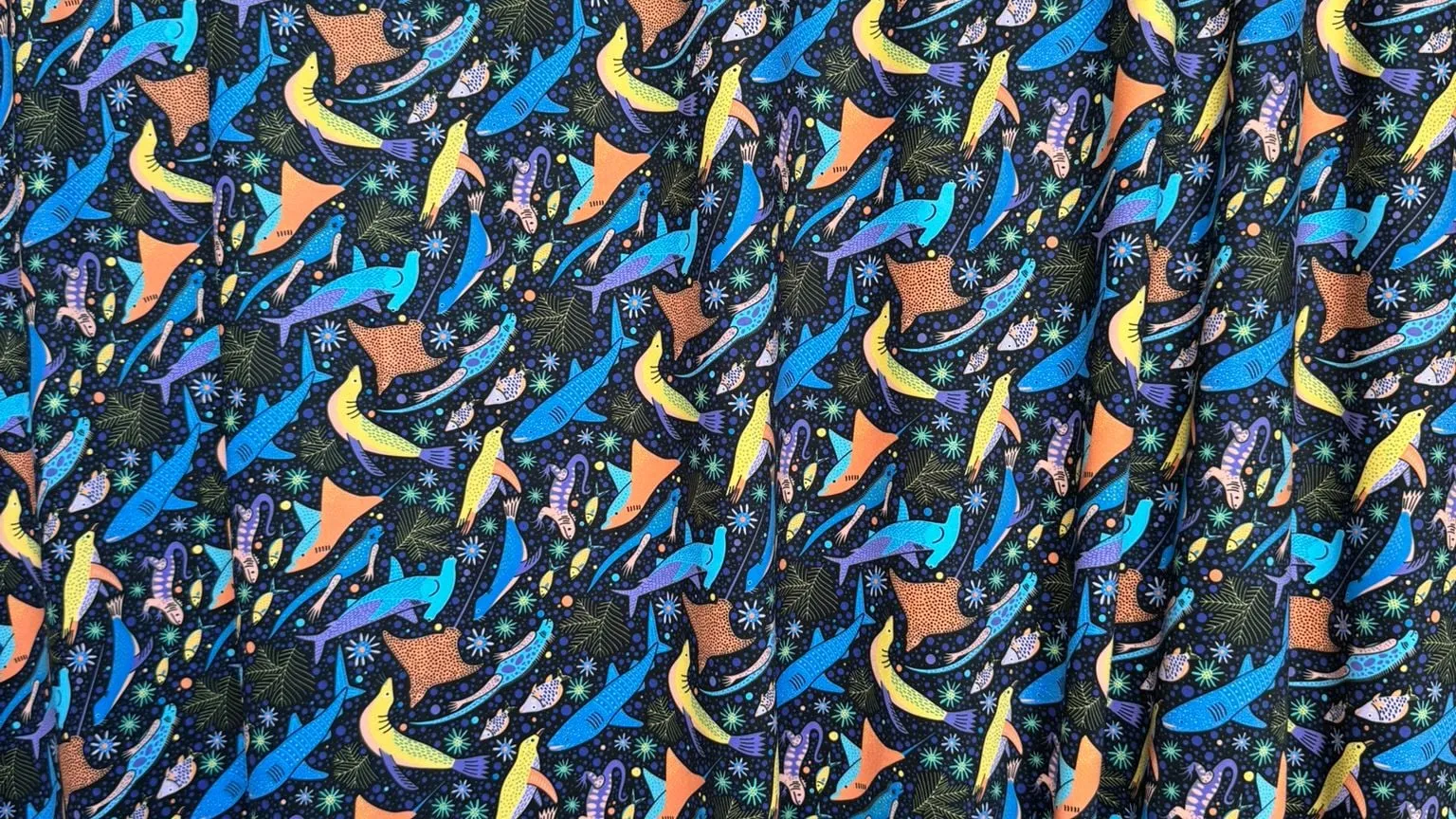
If you are printing your own stretch fabric, order a sample swatch first and pull it in the direction the finished garment will stretch. A print that looks perfect lying flat can look like something else entirely once it is wrapped around a calf.
One machine was never going to be enough
At the start I genuinely thought this was a one-purchase problem. Buy a sewing machine, watch some videos, make socks.
What actually happened is that I spent months learning to sew properly. I took courses. I made bags, then a pullover, then shirts, none of which had anything to do with socks and all of which taught me something I needed later. Sewing turned from a means to an end into a hobby that has long outlived its original purpose.
Then came the realisation that a normal sewing machine cannot do what sportswear needs. Stretch seams want an overlock, which trims and encloses the edge as it sews and lets the seam move with the fabric instead of popping the first time you yank a sock over your heel. Then the hems wanted a coverstitch machine, because that flat twin-line finish on the cuff of every piece of athletic wear you own does not come from a normal machine either.
So one machine became three, one at a time, until my desk looked like this.
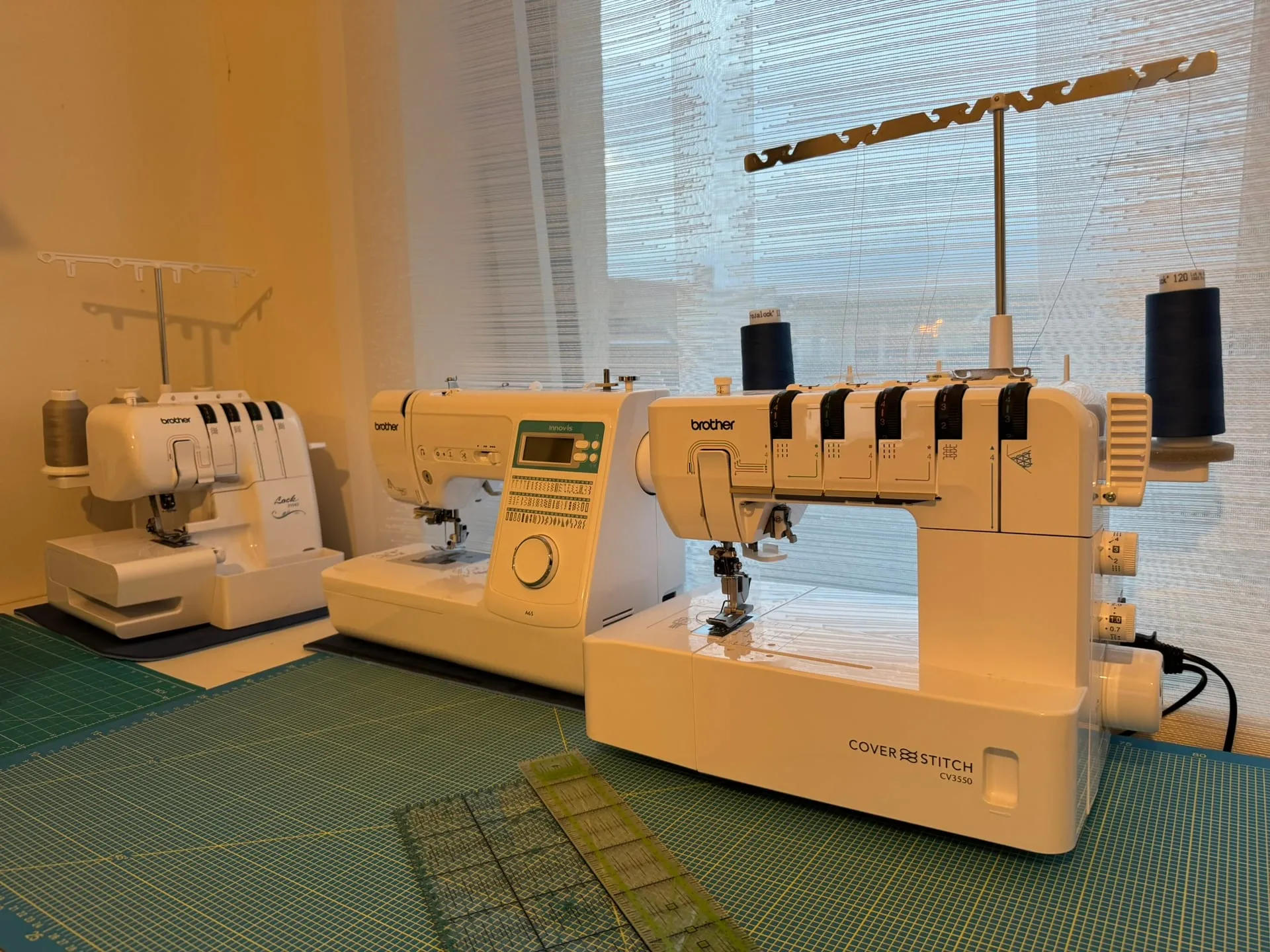
Left to right: the one I thought I needed, and the two I actually needed.
Genuinely useful if you are considering the same descent into madness: plenty of people buy this equipment, use it twice and give up. The secondhand market for overlocks and coverstitch machines is excellent. Mine did not all arrive new.
Then, finally, socks
Right fabric, right print orientation, right machines, and the socks got good. The tube sat straight. The cuff behaved. I pulled a pair on, tested them against a wetsuit cuff, and they did the one thing the whole idea depended on. They glided.
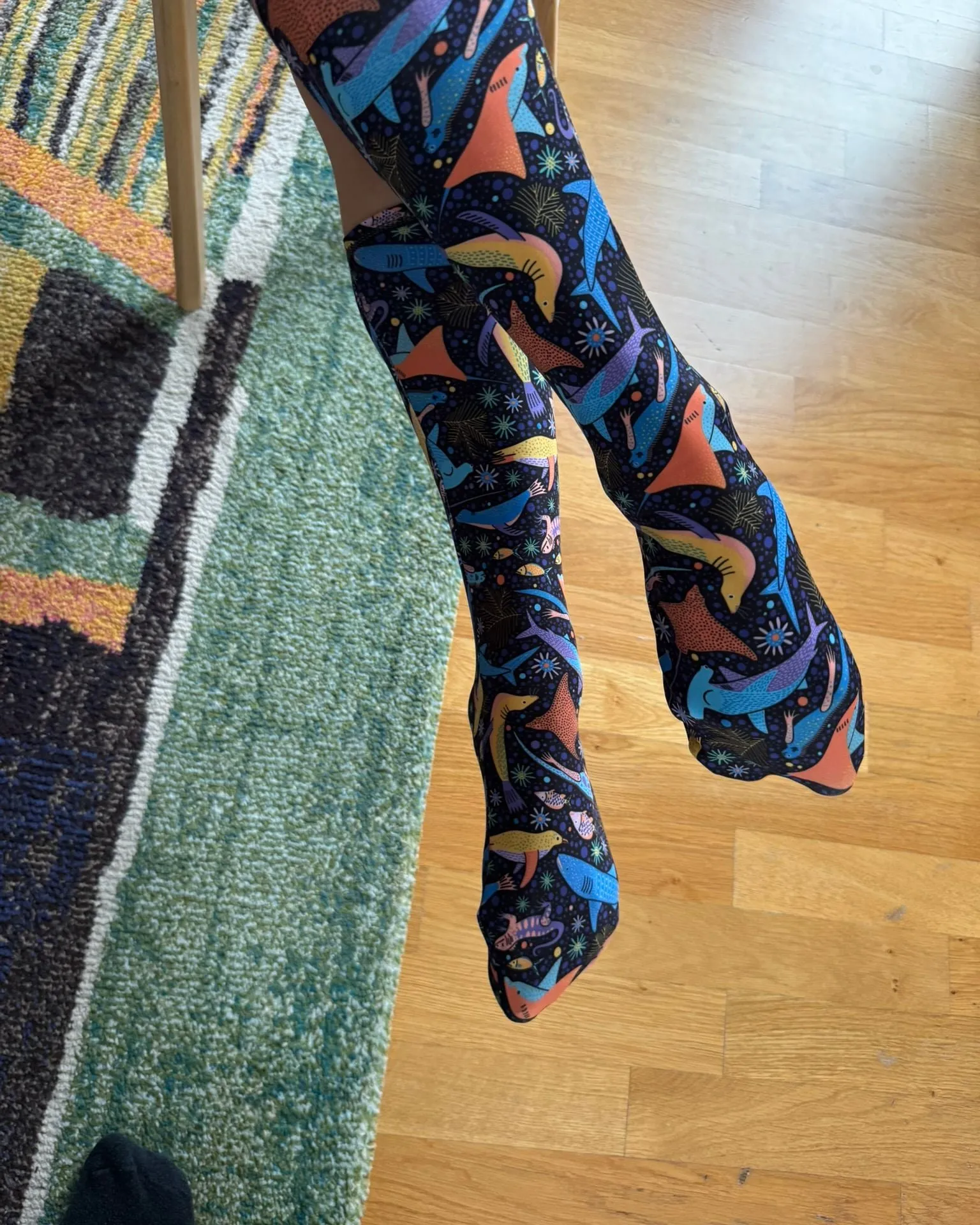
The ones that finally worked. Same fabric, rotated print, three machines’ worth of learning.
The rashguard that came out semi-good
Once the socks worked I got ambitious and tried a rashguard. It came out semi-good, and that is me being generous with myself.
It taught me a completely different set of things though. How a raglan shirt is actually built, why the sleeve seam runs where it runs, and how high a neckline has to sit before it stops being a styling decision and starts being useful on a dive. Too low and your wetsuit collar chews on your neck. Too high and you cook on the surface interval. There is a right answer and it is narrower than you would think.
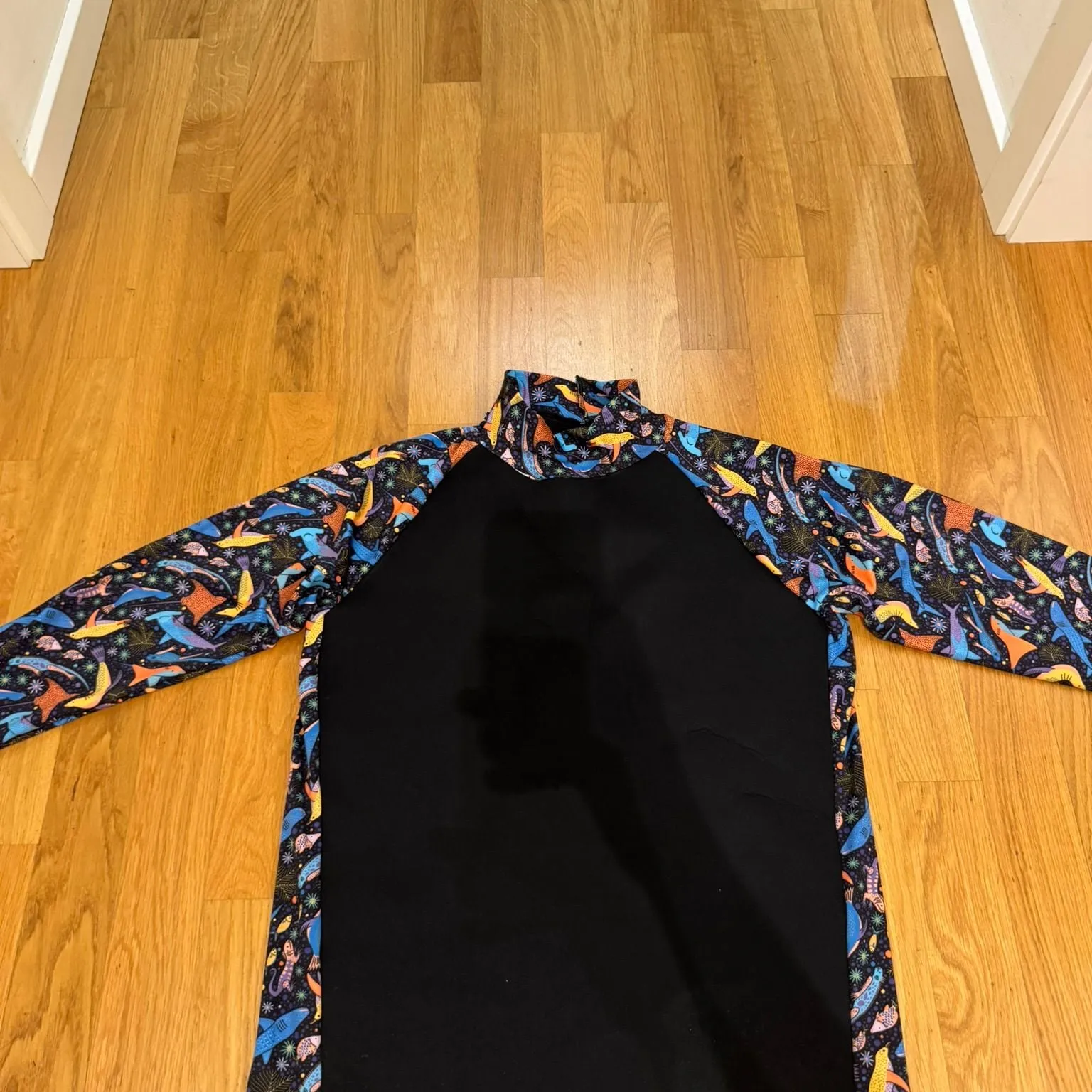
Semi-good. But I now know exactly why.
Why bother, when a factory will do it later
Fair question. The honest answer is that you cannot test an idea that does not exist yet. Before spending real money on production we needed to hold the actual thing, put it on, wrestle it into a wetsuit, and find out whether the idea we kept talking about worked in the water rather than in our heads.
So once I had a handful of prototypes that did not fall apart, we packed them and took them diving in the Galápagos, handed pairs to friends on the boat, and watched what happened. Spoiler: the hand-sewn generation held up better than my sewing deserved.
Everything I learned making them by hand went straight into the tech pack later. How much stretch the cuff needs. Where the seam sits so it does not rub. Which way the print has to run. All the things a factory now receives as a specification, I first understood with a needle in my hand and one ruined order behind me.
If you are sitting on an idea and waiting for someone else to make it real, consider being annoying about it and just making a rough one yourself. Worst case you learn what “rotated” means. Stay soggy.